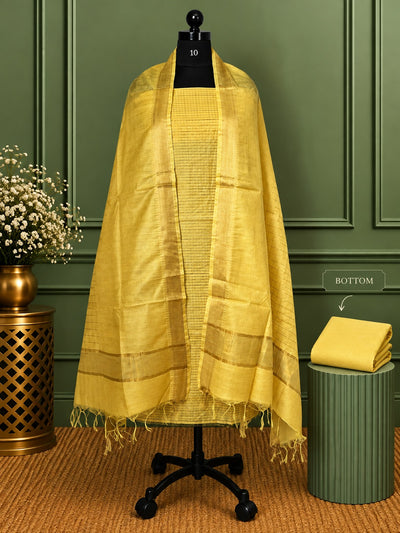
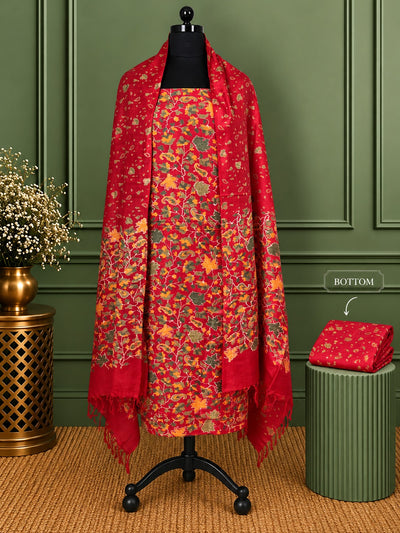
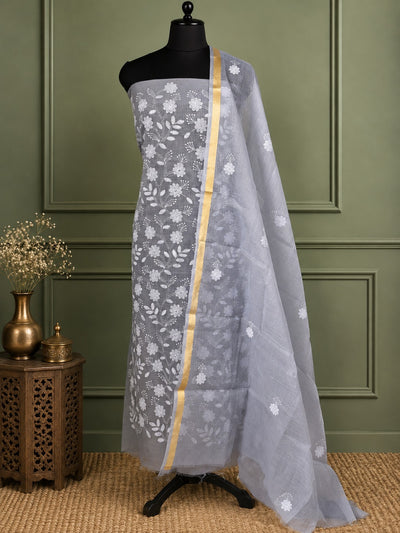
Gold Yellow Katan Silk Suit, Multicolour Striped Dupatta | Kairi
The dupatta makes the statement; the tunic stays calm.
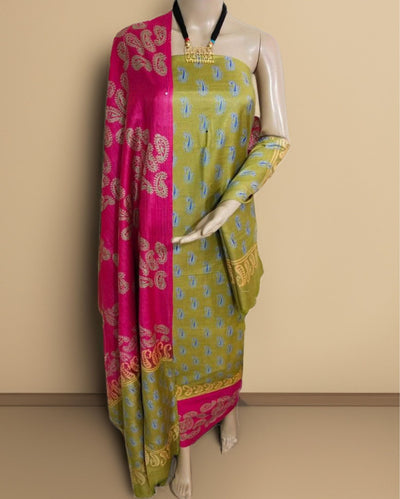
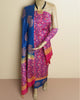
Red, blue and pink stripes are blocked over a quiet gold-olive base.

A quiet gold-olive tunic, then a dupatta striped in red, blue and pink.
Why this piece
- Genuinely hand block printed with hand-carved wooden blocks, never screened
- The dupatta is the statement piece - the tunic is deliberately understated
- Opaque, unlined, and light at 600 to 650 g across all three pieces
Tunic and dupatta
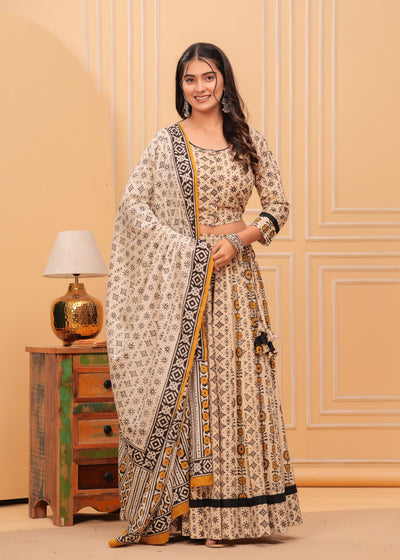
The tunic length is printed with small repeating geometric shapes in a gold-toned olive, with a straight solid red band at the hem. The dupatta goes the other way entirely: paisley and diagonal stripes in red, blue, pink, white and yellow, at a larger scale, with the same solid red band closing its end.
That red band is the thread tying the two together, and it is why a busy dupatta and a quiet tunic read as one set rather than two.
Wearing it
Stitch the tunic plain and let the dupatta carry the outfit - this is the set for a festive lunch or a day wedding where you want colour without wearing it head to toe. Gold jewellery picks up the tunic; a plain red or yellow inner picks up the band.
Two entirely different prints in one set, both stamped by hand, is a lot of block work for the price. Most sets at this level repeat one print across all three pieces.
The set
Top: 2.5 m, 44 to 45 inches wide
Bottom: 2.5 m, 44 to 45 inches wide
Dupatta: 2.5 m, 35 to 36 inches wide
Fabric: Katan silk, hand block printed with hand-carved wooden blocks
Lining: not required, the fabric is opaque; add one only to elevate the look
Stitching: up to 4XL for straight kurta sets, with length customised for larger sizes
Weight: 600 to 650 g for top, bottom and dupatta together
Care: dry clean the first time, then a gentle cold hand wash
Dispatch: dispatched the next working day, even though every metre is printed by hand
Collection: Kairi
The stripes on the dupatta are not perfectly parallel from edge to edge. That is a block laid by hand, and it is what you are paying for.
Exchange: *Easy exchange is available within 3 days of receiving the product.
*No exchanges on home decor items.
*Unboxing video is required.
Return: *Only for damaged/wrong products.
*Unboxing video required.
Learn More
Is the dupatta a different print from the top?
Yes - the tunic carries small geometric shapes in a gold-toned olive, while the dupatta is printed with larger paisley and diagonal stripes in red, blue, pink, white and yellow. A solid red band on both ties them together.
Will the bright dupatta colours run onto the lighter tunic?
The fabric is colour-fast and does not bleed on the first wash. Dry clean the set the first time, then wash gently in cold water.
What does the set include and how much fabric is there?
Three unstitched pieces: top 2.5 m and bottom 2.5 m at 44 to 45 inches wide, and dupatta 2.5 m at 35 to 36 inches.
Do I need a lining under the tunic?
No - the fabric is opaque as it is. Add a lining only if you want a heavier, more formal fall.
What if the shade is not what I expected on screen?
If the shade or the quality is not what you hoped for, an exchange is available - write to us and we will sort it out.

YOU MAY ALSO LIKE
RECENTLY VIEWED PRODUCTS
All Products, Best Selling Products, Ganesha Chaturthi, Gudi Padwa Sale, Independence Day Sale, Kairi, Katan Silk Dress Material, Katan Silk Printed Suit Piece Buti Design Handblock Print, New Arrivals, Newest Products, Puthandu Sale, Rakshabandhan Collection, Rang Rasiya, Savan, Silk Dress Material, Suits and Dupatta, The Summer Affair