


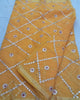
Tye & Drape Brown & Blue Kota Cotton Saree
Airy enough for a full workday, polished enough for meetings
Handcrafted at Indiehaat Unit in Kota, Master Artisan: Haq Nawaz

Elevate your style with a Kota Cotton Bandhej and Shibori Work Saree, featuring intricate hand-dyed patterns and a lightweight drape. Perfect for festive and casual elegance with a traditional touch.
Work: Bandhej Shibori
Measurements: 5.4-5.5 Meter
Blouse Piece: 80 cm
Fabric: Kota Cotton
Package Contains: 1 Saree with Blouse Piece
Wash Care: Gentle Handwash with Mild detergents. Wash separately. Dry in Shades.
Disclaimer:
Color hues may slightly vary from that which appears in the image due to different screens and displays
Minor irregularities is the uniqueness of handcrafted products and makes each piece exquisite
| Fabric / Material | Kota Cotton |
| Craft / Technique | Bandhej Tie Dye, Shibori Tie Dye |
| Colour | Brown, Blue |
| Origin / Cluster | Kota |
Bandhej Shibori Work is a fusion of two traditional tie-dye techniquesâ€â€**Bandhej (Bandhani)** from India and **Shibori** from Japan. Bandhej involves tightly tying fabric at various points before dyeing, creating small, intricate dot patterns, while Shibori uses folding, twisting, and stitching methods for abstract and fluid designs. This blend results in vibrant, textured fabrics with unique resist-dyed patterns, often used in sarees, dupattas, and ethnic wear.
Exchange: *Easy exchange is available within 3 days of receiving the product.
*No exchanges on home decor items.
*Unboxing video is required.
Return: *Only for damaged/wrong products.
*Unboxing video required.
Learn More
How does the pallu contrast with the body on the Tye & Drape saree?
The body is a cool, dotted blue, while the pallu breaks into warm, earthy tie-dye streaks with a narrow gold edge. That warm-against-cool contrast gives the saree its character: draped, the pallu falls over the shoulder as a bright splash against the calmer body.
What does the border look like?
A deeper blue band runs along the edge, carrying the same white dots as the body and finished with a fine gold line. It frames the saree neatly without adding weight, so the overall look stays light and easy for daytime wear.
How sheer is the fabric?
Kota cotton is woven in its signature checkered khats weave and is sheer by nature, so it lets some light through. Wear it with a well-fitted petticoat in a matching blue; it keeps the drape clean and stops the pleats from showing what is underneath.
How should I care for it?
Give it a gentle hand wash with a mild detergent, wash it on its own, and dry it in the shade. Being hand-dyed, it is best kept away from white or light clothes in the wash. A light steam or a warm iron on the reverse brings back the crisp Kota finish.
Why are the dots not perfectly even?
Every dot is a point that was tied by hand before dyeing, and every streak on the pallu comes from fabric folded and bound by hand. So spacing, size and the spread of colour shift slightly across the saree and from one piece to the next. That small irregularity is the sign of real tie-dye, not a flaw.
Which blouse colour should I pick?
For an easy match, go for a blouse in the deep blue of the border. If you want the pallu to lead, choose a warm, earthy tone that picks up its streaks. A gold-toned blouse works well for festive wear and echoes the fine gold edge along the border.




More sarees in brown
View all 23% off
 14% off
 20% off
 18% off
 30% off
 20% off
 23% off
 32% off
Bright & playful sarees for kitty parties & brunch
View all 17% off
 20% off
 8% off
 32% off
 32% off
 15% off
 21% off
 18% off
Handcrafted by Kota artisans
View all 18% off
 27% off
 22% off
 32% off
 28% off
 33% off
 27% off
 32% off
RECENTLY VIEWED PRODUCTS
Ada-e-Ramazan, All Products, Bandhej & Lehariya, Best Selling Products, Cotton Sarees, Diwali Sale, Festive Sarees, Independence Day Sale, Kitty & Brunch Sarees, Kota Cotton Sarees, Kota Sarees, Linen And Cotton Sarees, New Arrivals, Newest Products, Office & Workwear Sarees, Playful Festive Sarees, Playful Kitty & Brunch Sarees, Playful Sarees, Playful Summer & Travel Sarees, Puthandu Sale, Rang Rasiya, Reception, Republic Day Collection, Sarees, Savan, Shibori & Tie-Dye, Summer & Travel Sarees, Tie & Dye Crafts, Ugadi - The New Year, Ugadi Sale
