


Rangira Silkmark Ghicha Tussar Silk Saree Bare Beige
Handcrafted at Indiehaat Bhagalpur Unit. Master Weaver: Wasif.

Silkmark Ghicha Tussar silk saree featuring all over Madhubani hand painting, crafted for artistic elegance and refined occasion wear. The natural Ghicha Tussar silk fabric offers a textured feel with a graceful drape, making it suitable for festive gatherings, cultural events, and celebrations.
Crafted by Wasif Ahmed from Bhagalpur, this saree reflects traditional Madhubani artistry where intricate motifs and storytelling patterns are painted by hand across the fabric, giving every piece a distinct handmade identity.
Work: Madhubani Hand Painting
Measurements: Saree 5.6-5.7 Meter | Blouse Piece 80 CM
Fabric: Silkmark Ghicha Tussar Silk
Blouse: Unstitched Blouse Piece Included
Package Contains: 1 Saree with Blouse Piece
Wash Care: Dry Clean Only
Disclaimer:
Color hues may slightly vary from that which appears in the image due to different screens and displays
Minor irregularities is the uniqueness of handcrafted products and makes each piece exquisite
| Fabric / Material | Ghicha Tussar Silk |
| Craft / Technique | Madhubani Hand Painting |
| Colour | Beige |
| Origin / Cluster | Bhagalpur |
**Madhubani Hand Painting** is a traditional folk art form from Bihar where artisans create intricate motifs and storytelling patterns by hand using detailed brushwork. This saree is crafted by Wasif Ahmed from Bhagalpur. Each painting is done manually, making every saree unique and reflective of authentic handmade artistry.
Exchange: *Easy exchange is available within 3 days of receiving the product.
*No exchanges on home decor items.
*Unboxing video is required.
Return: *Only for damaged/wrong products.
*Unboxing video required.
Learn More
What is painted on this saree?
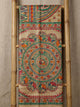
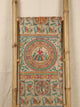
A large scalloped mandala fills the pallu, with birds in its petals, a ring of red triangles and a green-teal frame around it. An arch panel and painted folk bands with geometric edging lead into the body, and the open beige ground around the mandala lets it stand out clearly.
Is there a blouse piece, and how much fabric is it?
Yes. An unstitched blouse piece of 80 cm comes in the package, separate from the saree length. Take it to your tailor along with your preferred style; if you want long sleeves or an elaborate back, check the fabric with them first.
What blouse would frame this saree?
Pick one strong colour from the painting, such as teal, red or deep green, to give the outfit a frame. A gold tissue blouse works for festive occasions and office parties. Or simply stitch the included 80 cm blouse piece for an easy, minimal look.
Will the hand painting last?
Yes, with proper care. Dry clean only, keep it away from moisture and direct sun, and store it folded in a breathable cloth. Avoid spraying perfume directly onto painted areas, and refold it occasionally so creases don't settle across the motifs.
How do I tell hand painting from a Madhubani print?
Look closely at the lines. Hand painting has brushstrokes that thicken and thin, colour that sits slightly heavier in some spots, and motifs that are similar but never identical. A print repeats exactly. On a hand-painted saree, these small irregularities are expected.
Who painted it?
It's crafted by Wasif Ahmed from Bhagalpur in Bihar. The Madhubani artwork is painted by hand across the saree, so every piece carries its own small variations in line and colour.
Are small irregularities in the painting a defect?
No. Minor irregularities are part of hand painting: a line that's slightly thicker, a colour fill that's a shade deeper in one corner. They show the saree was painted by a person, not a machine, and they make each piece a little different from the next.



More sarees in beige
View all 21% off
 14% off
 7% off
 21% off
 23% off
 23% off
 12% off
 23% off
Bright & playful sarees for festive days
View all 17% off
 20% off
 8% off
 32% off
 32% off
 15% off
 18% off
 21% off
Handcrafted by Bhagalpur artisans
View all 18% off
 32% off
 17% off
 10% off
 24% off
 14% off
 32% off
 18% off
RECENTLY VIEWED PRODUCTS
Ada-e-Ramazan, All Products, Best Selling Products, Bhagalpur, Bhagalpur Sarees, Diwali Sale, Festive Sarees, Independence Day Sale, Kitty & Brunch Sarees, Madhubani, New Arrivals, Newest Products, Office & Workwear Sarees, Office Party Sarees, Playful Festive Sarees, Playful Kitty & Brunch Sarees, Playful Sarees, Printed & Painted Crafts, Pure Tussar Silk Saree, Puthandu Sale, Sarees, Savan, Silk Sarees, Silk Sarees Ad, Silkmark Certified Products, Silkmark Certified Sarees, Silkmark Certified Tussar Silk Madhubani Handpainted Saree, Silkmark Tussar Silk Sarees, Ugadi - The New Year, Ugadi Sale, VaraMahalakshmi Sale
