


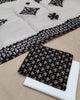
Silkmark Tussar Beige Madhubani Tranquil Dupatta & Black Top
Handcrafted at Indiehaat Bhagalpur Unit. Master Weaver: Wasif.

Make a style statement with our Handcrafted Silkmark Tussar Madhubani Suit. Featuring traditional Madhubani paintings on Tussar silk fabric, each suit exudes elegance and charm, perfect for weddings, festivals, and special occasions, adding a touch of cultural flair to your look.
Work: Madhubani Blockprint
Measurements: Top: 2.4-2.5 Meter Length, Width: 44 Inches
Dupatta: 2.3-2.4 Meter Dupatta, Width: 32-33 Inches
Fabric: Silkmark Certified Tussar Silk
Package Contains: Unstitched Fabric: Top + Dupatta
Wash Care: Dry Clean Only. Keep them in separate bags in a dry place. Change folds and expose to non-moist air regularly. Dry in Shades.
Disclaimer:
Color hues may slightly vary from that which appears in the image due to different screens and displays
Minor irregularities is the uniqueness of handcrafted products and makes each piece exquisite
| Fabric / Material | Tussar Silk |
| Craft / Technique | Madhubani Block Print |
| Colour | Black |
| Origin / Cluster | Bhagalpur |
Exchange: *Easy exchange is available within 3 days of receiving the product.
*No exchanges on home decor items.
*Unboxing video is required.
Return: *Only for damaged/wrong products.
*Unboxing video required.
Learn More
What is on the dupatta's end panel?
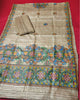
The end panel shows a pair of Madhubani-style peacocks in orange, blue, green and pink, set between leaf-vine, zigzag and triangle bands, with a scalloped flower edge. The rest of the beige tussar stays plain, and that contrast between the quiet body and the bright panel is the charm.
How do I style the black top?
The top reads as a deep charcoal-black, which makes the colourful peacocks stand out. Beige or cream bottoms keep it crisp for the office; a red bottom adds an evening edge. Oxidised silver jewellery suits it.
What is Madhubani, and how does it appear here?
Madhubani, also called Mithila painting, is a folk art from the villages of Bihar, known for intricate, colourful imagery. On this set it appears on the tussar dupatta as Madhubani block print, so you get the traditional imagery on a wearable silk.
Is a lining needed for the kurta?
It isn't required, but a light cotton lining is a good idea with silk. It adds comfort for long office days, gives the kurta a cleaner fall, and reduces wear on the tussar. Choose a lining in a close shade.
Any tips for my tailor?
Ask for finished seams, such as overlocking, as silk edges can fray. Press on a low setting with a cotton cloth between the iron and the fabric, and avoid spraying water directly on the silk. With 2.4 to 2.5 metres in 44-inch width, discuss the cut and sleeve length before cutting.
Can I wash it at home?
Please don't. It is dry clean only, which protects the silk and the Madhubani work. Between wears, keep it in a separate cloth bag, refold it along new lines occasionally, and air it on dry days.
Will the Madhubani colours run?
Keep the printed silk away from water, which is why it is dry clean only. Avoid spills, don't spray perfume directly on the printed area, and store it in its own bag away from damp. That care protects both the tussar and the Madhubani colours.



RECENTLY VIEWED PRODUCTS
All Products, Best Selling Products, Bhagalpur Suits, Black Suits, Earthy Festive Suits, Earthy Office & Workwear Suits, Earthy Office Party Suits, Earthy Suits, Evening & Dinner Suits, Festive Suits, Kitty & Brunch Suits, Madhubani, New Arrivals, Newest Products, Office & Workwear Suits, Office Party Suits, Printed & Painted Crafts, Puthandu Sale, Rakshabandhan Collection, Savan, Silk Dress Material, Silkmark Certified Products, Silkmark Certified Suits, Suits & Dress Material, The Summer Affair, Tussar Silk Madhubani Dupatta And Plain Tussar Silk Top
