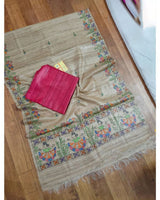
Silkmark Tussar Beige Madhubani Colorful Dupatta & Pink Top
Handcrafted at Indiehaat Bhagalpur Unit. Master Weaver: Wasif.

Make a style statement with our Handcrafted Silkmark Tussar Madhubani Suit. Featuring traditional Madhubani paintings on Tussar silk fabric, each suit exudes elegance and charm, perfect for weddings, festivals, and special occasions, adding a touch of cultural flair to your look.
Work: Madhubani Blockprint
Measurements: Top: 2.4-2.5 Meter Length, Width: 44 Inches
Dupatta: 2.3-2.4 Meter Dupatta, Width: 32-33 Inches
Fabric: Silkmark Certified Tussar Silk
Package Contains: Unstitched Fabric: Top + Dupatta
Wash Care: Dry Clean Only. Keep them in separate bags in a dry place. Change folds and expose to non-moist air regularly. Dry in Shades.
Disclaimer:
Color hues may slightly vary from that which appears in the image due to different screens and displays
Minor irregularities is the uniqueness of handcrafted products and makes each piece exquisite
| Fabric / Material | Tussar Silk |
| Craft / Technique | Madhubani Block Print |
| Colour | Beige, Pink |
| Origin / Cluster | Bhagalpur |
Exchange: *Easy exchange is available within 3 days of receiving the product.
*No exchanges on home decor items.
*Unboxing video is required.
Return: *Only for damaged/wrong products.
*Unboxing video required.
Learn More
What is painted on the dupatta?
Dancing figures in flared, patterned skirts, with foliage between them, form a wide folk-art band edged with a geometric border, and small buti are scattered across the rest of the dupatta. The beige tussar ground keeps the green, orange, blue and teal in the artwork lively.
What goes with the pink top?
The pink is a strong, warm shade. A cream or beige bottom keeps it office-ready; a green bottom echoes the plants in the Madhubani panel for a festive look. Silver or terracotta jewellery suits it.
Why are tussar and Madhubani paired together?
Both belong to Bihar. Much of India's tussar comes from Bhagalpur, where it is known as Bhagalpur silk, and Madhubani art comes from the Mithila region of the same state. The set brings a Bihar fabric and a Bihar art form together.
Should I line the top?
Lining is your choice, but many people prefer a soft cotton lining in silk kurtas. It makes the top more comfortable against the skin, helps it hold its shape, and protects the silk from perspiration. Ask your tailor to match the lining to the top colour.
How should the kurta be cut?
The top fabric is 2.4 to 2.5 metres in 44-inch width, so talk through the length, flare and sleeves with your tailor before cutting. A simple straight or A-line kurta lets the tussar and the Madhubani dupatta take the attention.





RECENTLY VIEWED PRODUCTS
All Products, Beige Suits, Best Selling Products, Bhagalpur Suits, Earthy Festive Suits, Earthy Office & Workwear Suits, Earthy Office Party Suits, Earthy Suits, Evening & Dinner Suits, Festive Suits, Independence Day Sale, Kitty & Brunch Suits, Madhubani, New Arrivals, Newest Products, Office & Workwear Suits, Office Party Suits, Pink Suits, Printed & Painted Crafts, Puthandu Sale, Rakshabandhan Collection, Savan, Silk Dress Material, Silkmark Certified Products, Silkmark Certified Suits, Suits & Dress Material, The Summer Affair, Tussar Silk Madhubani Dupatta And Plain Tussar Silk Top, Valentine Edit, Valentines Edit Pink