


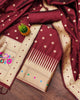
Noor-e-Banaras Lichi Silk Maroon Suit (T+B+D) Brocade Weaving
Handcrafted in Udhna, Gujarat by master weaver Rashmi.

Elevate your ethnic charm with our Banarasi Lichi Silk Suit featuring exquisite brocade weaving. Perfect for festive occasions, this suit showcases luxurious texture, intricate craftsmanship, and timeless traditional elegance.
Work: Brocade Weaving
Weight: 500 gm
Measurements: Top: 2.5-3.0 Meter, Bottom: 2.4-2.5 Meter, Dupatta: 2.4-2.5 Meter
Fabric: Banarasi Lichi Silk
Package Contains: Unstitched Fabric: Top + Bottom + Dupatta
Wash Care: Dry Clean Preferred or Gentle Handwash with Mild detergents. Wash separately. Dry in Shades.
Disclaimer:
Color hues may slightly vary from that which appears in the image due to different screens and displays
Minor irregularities is the uniqueness of handcrafted products and makes each piece exquisite
| Fabric / Material | Banarasi Lichi Silk |
| Craft / Technique | Brocade Weaving |
| Colour | Maroon |
| Origin / Cluster | Gujarat |
**Brocade Weaving** is a luxurious textile technique where decorative patterns are woven into the fabric, often using gold or silver threads. Originating in India, it creates raised motifs like florals, paisleys, or geometric designs. Commonly used in Banarasi sarees, brocade weaving adds opulence, texture, and richness to traditional garments and upholstery.
Exchange: *Easy exchange is available within 3 days of receiving the product.
*No exchanges on home decor items.
*Unboxing video is required.
Return: *Only for damaged/wrong products.
*Unboxing video required.
Learn More
What does (T+B+D) in the name mean?
It stands for Top, Bottom and Dupatta, the three pieces in the set. All three come as unstitched fabric: 2.5 to 3.0 metres for the kurta, 2.4 to 2.5 metres for the bottom, and a dupatta of 2.4 to 2.5 metres. You'll need a tailor for the kurta and the bottom.
Where should the paisley border go when it's stitched?
At the hem, where it's woven to sit. Ask your tailor to plan the kurta length around the border instead of cutting into it, and to centre the rows of paisley butas on the front panel. A straight or slightly flared cut keeps the border flat and readable.
Is maroon only for festive occasions, or can I wear it out to dinner?
Festive occasions are its first setting: the deep maroon and brocade zari feel warm and rich at a festival gathering. It also moves easily to an evening dinner, where antique-gold jewellery and small jhumkas keep it handsome without going over the top.
How heavy is the set?
The three unstitched pieces weigh about 500 gm together. Lichi silk with brocade has some body, so a kurta holds a neat line. The final weight depends on your lining and cut; a light cotton lining keeps it comfortable for longer wear.
What style of bottom can I get from the bottom piece?
With 2.4 to 2.5 metres, most tailors can make straight pants, cigarette pants or a regular salwar for most sizes. A very full patiala or a wide palazzo may need more, so check with your tailor. Straight pants keep the look smart for work; a salwar feels more traditional.




More suits in maroon
View all 21% off
 23% off
 21% off
 37% off
 32% off
 24% off
 23% off
 7% off
Rich & regal suits for festive days
View all 14% off
 14% off
 37% off
 18% off
 14% off
 37% off
 14% off
 37% off
Handcrafted by Gujarat artisans
View all 41% off
 41% off
 41% off
 41% off
 41% off
 41% off
 32% off
 41% off
RECENTLY VIEWED PRODUCTS
All Products, Banarasi & Brocade, Best Selling Products, Evening & Dinner Suits, Festive Suits, Ganesha Chaturthi, Gujarat Suits, Handwoven Crafts, Labor Day Loyalty, Lichi Silk Suit Set, Maroon Suits, New Arrivals, New Spring arrivals, Newest Products, Puthandu Sale, Rakshabandhan Collection, Regal Festive Suits, Regal Suits, Savan, Silk Dress Material, Suits & Dress Material, Suits and Dupatta, The Summer Affair, Ugadi Sale
