Handcrafted Details Influence Home Decor Trends
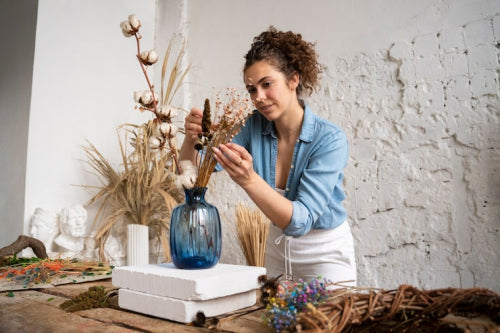
Picture a sunlit loft in Brooklyn, where a vibrant handwoven rug from Rajasthan unfurls across the hardwood floor, its detailed motifs dancing in the light. Beside it stands a meticulously restored wooden chair from Gujarat, harmonizing effortlessly with a modern mid-century sofa. This scene isn't merely a living space; it's a narrative crafted from cultural heritage and skilled artistry. Worldwide, homeowners are rejecting uniform, factory-made furnishings in favor of artifacts that embody heritage, emotion, and human touch. The surge in handcrafted home décor, especially from India's rich artisan traditions, is revolutionizing interior design in 2025, merging genuine roots with contemporary elegance.
Fast fashion erodes cultural heritage, sidelining artisans and reducing traditions to trends. At IndieHaat, we champion India's craftspeople with handcrafted sarees, apparel, décor, and skincare rooted in authenticity. Each piece embodies skill and ethical care. Support artisans and preserve India's timeless legacy Shop Now!
Handcrafted Details Reshape Home Décor Trends in 2025
The transformation in consumer preferences is profound and undeniable. Shoppers are abandoning the bland uniformity of chain-store products, opting instead for singular items that narrate personal tales. A recent report from Persistence Market Research forecasts the global home décor market reaching US$ 768.5 billion in 2025, expanding at a compound annual growth rate of 4.5% until 2032, when it will achieve US$ 1,045.8 billion. This expansion stems from evolving tastes, innovative designs, and a strong desire for tailored living spaces that incorporate elements like lighting fixtures, fabrics, and ornamental accents. The push for eco-conscious products and greater focus on interior aesthetics further accelerates this market's vitality. For example, Bali's Nusantara Lifestyle introduced furnishings in October 2024 that fuse contemporary and traditional styles for upscale villas, hospitality venues, and private residences.
The furniture segment led the market, driven by innovative designs, while lighting gained prominence thanks to aesthetics and wellness considerations. Online sales channels are increasingly popular, offering convenience and cost-effective options, exemplified by collaborations like Creaticity's partnership with Thailand's Index Living Mall to bring a new outlet to India targeting urban families and design enthusiasts. Regionally, North America remains a frontrunner, spurred by demand for comfortable, stylish, and sustainable living spaces, highlighted by initiatives such as Ashley and Samsung's Connected Home Experience. Europe follows closely, with creative offerings and professional trade initiatives shaping market growth, particularly in the U.K.
Additional drivers include the rise of do-it-yourself endeavors and custom goods, with companies like Govee unveiling the Neon Rope Light 2 in March 2024 and IKEA initiating IKEA Preowned in August 2024 to promote circular economy goals by 2030. From 2019 to 2024, the market grew at 4.11% CAGR, supported by digital retail expansion and interest in safe, non-toxic materials. Handmade elements, such as artistically painted pottery, stitched bedcovers, and elaborately sculpted furnishings, lie at the core of this momentum. In India, with its centuries-old crafting legacy, this movement represents a resurgence of culture alongside international appeal.
What fuels this evolution? Beyond mere appearance, individuals seek bonds amid rapid lifestyles and social turbulence. An insightful piece in House Beautiful explores the surge in grandmotherly aesthetics, attributing it to deep-seated nostalgia a beneficial, communal feeling that links people to ancestral figures and aids in dealing with irretrievable pasts. Marketers capitalize on this through nostalgia-driven campaigns, invoking security and evoking less complicated eras. Today's accelerated pace, coupled with political tensions, financial instability, and swift digital evolutions, breeds widespread fatigue, especially in youth. This fosters a craving for straightforwardness, customs, and decelerated rhythms, which these vintage-inspired styles and pursuits deliver.
Illustrations abound: coastal grandmother evokes a light, simple, seaside ambiance, while cottagecore delivers soothing, warm, rural sophistication. Younger demographics are shifting culturally toward leisurely pastimes such as knitting, horticulture, and embroidery, seeking firmness, legacy, and experiences to savor rather than orchestrate. Pinterest's latest Fall Trends Report for 2025 reinforces this, declaring neutral tones obsolete and assembly-line furniture passé. It urges swapping drab couches and plain walls for antique plush seating and manually decorated earthenware. The data indicates skyrocketing interest in designs rich with individuality artifacts boasting backstory, charm, and narrative.
Specifically, queries for vintage maximalism have risen 260%, and handpainted furniture hunts have jumped 135%. Users favor items that whisper tales over those demanding setup guides. This pivot arises from realizations that uniform purchases fail to forge true abodes. As the report aptly states, if a sitting area suits anybody, it suits nobody. Moreover, awareness of disposable furniture's ecological toll grows, with U.S. residents discarding 12 million tons yearly, prompting thrift-savvy approaches dream thrift discoveries up 550% for Gen Z.
A Tapestry of Tradition and Modernity
Handmade interiors flourish by linking eras. Craftspeople merge age-old methods such as stencil imprinting, manual textile production, and ancient bronze casting with fresh aesthetics suitable for city flats and expansive estates. Consider the Graham & Green vintage line, unveiled for the U.K. company's half-century milestone. Drawing from Indian origins, it showcases refurbished rustic seats and classic stitched comforters that align with current retro furnishing fads yet exude enduring grace unique to aged treasures.
Homeowners increasingly eschew factory goods for singular antiques, a change designers welcome heartily. This highlights a core principle: dwellings adorned with distinctive elements become more intimate, vibrant, and influential. Sourcing such secondhand gems poses difficulties, but this family-operated label eases the hunt with an exquisite array of revived artifacts. The assortment stands as a prime destination for spirited household items that infuse residences with identity.
Within India, makers gain fresh patrons via worldwide sites like Etsy and partnerships with entities such as West Elm and IKEA. Woven pillows from Kutch, clay containers from Rajasthan, and folk-art murals from Bihar adorn dwellings from Indian metropolises to American hubs. Their charm stems from singularity: each item varies, marked by artisan nuances. This fused style spare yet layered complements current preferences while respecting origins. An interior expert once remarked that a latticed partition, hand-chiseled, can vitalize a barren area, imbuing it with vitality.
Expanding on this, the U.S. segment mirrors global patterns. Per Mordor Intelligence, the U.S. home décor sector stands at USD 215.21 billion for 2025, climbing to USD 263.21 billion by 2030 at 4.11% CAGR. Leading firms like Home Depot, Lowe's, IKEA USA, Williams-Sonoma, and Wayfair dominate, with moderate rivalry. Furniture tops categories at 37.22% revenue in 2024, home-office pieces growing fastest at 9.90% CAGR. Wood leads materials with 42.75% share, reclaimed variants at 8.83% CAGR. Specialty stores hold 44.6%, e-commerce surging at 10.41%. Mass pricing prevails at 68.34%, premium at 7.83% growth. Southern states claim 33.56%, West expanding at 6.12%. Remote work boosts multifunctional demands, housing initiations rose 11.2% in February 2025, and sustainability preferences rise, aided by AR technologies.
Challenges in Scaling Craft
Despite its magnetism, the handmade décor expansion encounters obstacles. Creators typically operate in modest groups, restricting output relative to industrial scales. Crafting one floor covering manually may span weeks, versus mechanical mass production. This constraint complicates growth amid escalating needs. Drawing from a March 2025 release, the worldwide handicrafts arena, assessed at roughly USD 1,005,487.5 million in 2022, anticipates hitting USD 2,317,183.92 million by 2030, advancing at 11.00% CAGR from 2023 onward. Yet, practitioners struggle to match pace.
Pricing presents another hurdle. Artisan works frequently exceed factory equivalents in cost, erecting access walls. A decorated clay holder could cost tenfold a standard version. Persuading buyers of inherent worth heritage, sentiment, ecology demands initiative. Many view such items as extravagances, not essentials. Logistics remain delicate, with maker groups susceptible to interruptions like resource deficits or fiscal fluctuations. Informing purchasers about item backstories challenges, though enterprises address it via inventive tales.
To elaborate, the sector's vigor owes to heightened fascination with distinctive, crafted wares and emphasis on green, regional sourcing. 2022's valuation mirrors classic skills and current stylings appealing broadly. Bolstered by higher earnings in developing areas and inclinations toward individualized, heritage-laden ornaments and attire. Future progress underscores ongoing appetite, propelled by online retail shifts, worldwide links, and artisan legacy consciousness. Innovators adapting to tastes position the field as pivotal for growth and tradition safeguarding.
Opportunities in a Digital Age
Obstacles notwithstanding, prospects abound. Digital commerce revolutionizes access, propelling makers internationally. Venues like Etsy and specialized Indian groups deliver woven mats and cane features globally. Accommodations and luxury retreats, akin to Nusantara's offerings, progressively adopt handmade for modern-traditional mixes. Building professionals and stylists engage, ordering custom pieces for elite ventures requiring distinctiveness.
The socioeconomic ripple is significant. Escalating interest empowers rural Indian artisans, where skills sustain existence. Linking producers to international arenas, labels nurture viable incomes and safeguard legacies. Sellers capitalize, weaving maker tales to foster confidence and devotion. A local enterprise recounted emphasizing weaver profiles per item, elevating mundane pillows to dialogue igniters.
Broadening, trends like multifunctional spaces and green materials gain traction. E-commerce's ascent, with 17.3% share, underscores convenience. Collaborations, such as Creaticity's, target specific demographics. North America's dominance reflects comfort quests, Europe's innovations like Conran's. DIY surges, with launches like Govee's lighting and IKEA's resale, promote sustainability.
A Memorable Crafting Homes with Soul
Reflecting on that Brooklyn setting the mat, the seat, their spatial metamorphosis into intimacy handmade décor transcends visuals; it embodies significance. Amid transient fads and throwaway commodities, these artifacts anchor us, connecting to lasting customs and narratives. Evidence supports: home décor nearing US$ 1,045.8 billion by 2032, handicrafts toward USD 2.3 trillion by 2030, authenticity's allure intensifies. Enterprises and buyers must embrace bolstering makers, adopting eco-methods, narrating origins. Ultimately, a residence rich in artisan touches isn't merely shelter. It's heritage embodied.
Frequently Asked Questions
Why are handcrafted home decor items becoming more popular in 2025?
Handcrafted home decor is surging because consumers are rejecting uniform, factory-made furnishings in favor of unique pieces with cultural heritage and personal stories. This trend is driven by nostalgia, a desire for authenticity amid fast-paced lifestyles, and growing awareness of disposable furniture's environmental impact. The global home decor market is expected to reach $1,045.8 billion by 2032, with handmade elements at the core of this growth.
How much more expensive are handcrafted decor items compared to mass-produced alternatives?
Handcrafted decor items typically cost significantly more than factory equivalents, with some artisan pieces like decorated clay holders costing up to ten times more than standard versions. However, buyers are increasingly willing to pay premium prices for items that offer heritage, emotional connection, and environmental sustainability. The challenge lies in educating consumers about the inherent worth of these unique, story-rich pieces.
Where can I buy authentic handcrafted home decor from Indian artisans?
Indian artisans now reach global customers through online platforms like Etsy and partnerships with major retailers such as West Elm and IKEA. You can find woven pillows from Kutch, clay containers from Rajasthan, and folk-art pieces from Bihar that ship worldwide. Digital commerce has revolutionized access to these authentic pieces, allowing rural Indian craftspeople to connect directly with international buyers seeking unique home decor.
Disclaimer: The above helpful resources content contains personal opinions and experiences. The information provided is for general knowledge and does not constitute professional advice.
You may also be interested in: Impact of Fast Fashion on Artisan Communities in India – Indiehaat
Fast fashion erodes cultural heritage, sidelining artisans and reducing traditions to trends. At IndieHaat, we champion India's craftspeople with handcrafted sarees, apparel, décor, and skincare rooted in authenticity. Each piece embodies skill and ethical care. Support artisans and preserve India's timeless legacy Shop Now!
Powered by flareAI.co